

Not one.
Not on page one. Not on page two.
This month we scanned 120 localized Google searches across 20 US and Canadian metros — personal injury, divorce, and criminal defence in each city. We stripped out the directories, the bar referral services, and the aggregators, and looked at which actual law firms ranked. Then we asked a simple question: who shows up for more than one practice area?
The answer should worry any firm with three practice areas on its homepage.
The full-service firm has a search problem
Walk into most multi-practice firms and the logic is sound. Family law feeds criminal files. Criminal clients come back with injury claims. One brand, one building, three revenue streams.
Google doesn’t see it that way.
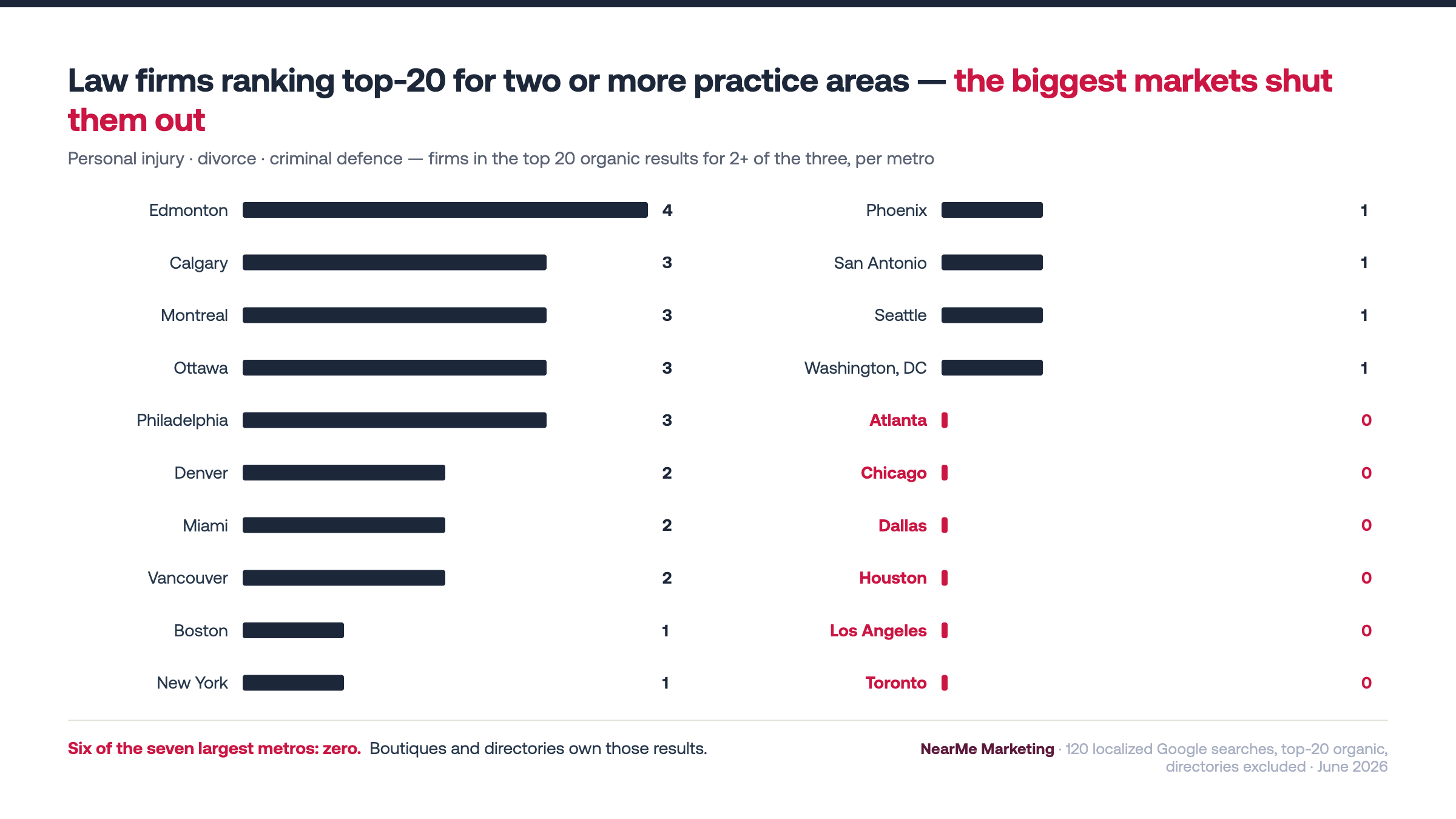
Out of hundreds of firms ranking across those 120 searches, only 28 appeared in the top 20 for two or more practice areas. Only four made the top 20 for all three — and only one swept page one. In the largest markets, the count was zero.
The search results in New York, LA, and Toronto belong to boutiques. The PI results go to PI-only firms. The divorce results go to family-law-only firms. A firm trying to rank for everything ranked for nothing.
Why boutiques win the big cities
The economics are straightforward. In a market where one personal injury case can fund a year of marketing, a PI-only firm pours its entire budget into one keyword set. A multi-practice firm splits the same budget three ways — and competes against a specialist on every front.
Market size made the difference everywhere we looked. Multi-practice firms were shut out of the mega-metros, held on in mid-tier markets like Phoenix, Miami, and Denver, and did best in Canadian cities, where legal marketing spend is an order of magnitude lighter.
One more pattern: of the 28 firms that ranked for two areas, the most common pairing by far was divorce + criminal. Personal injury was the hardest area to hold alongside anything else — it appeared in only 8 of the 28. PI is the most lucrative keyword set in law, and it attracts the most specialized competition.
The firms that beat the odds
A handful of firms genuinely hold their own against the boutiques. They’re worth studying.
Chadi & Ibrahim LLP in Edmonton swept all three practice areas: #1 for personal injury, #2 for divorce, #3 for criminal defence. Twelve lawyers, two offices, and the single best multi-practice performance in the entire study.
Price Benowitz LLP in Washington, DC was the only US firm close to a page-one sweep of all three — page one for both divorce and criminal defence in one of America’s most competitive legal markets.
Stephen Bilkis & Associates was the lone multi-practice winner in New York City: #1 for divorce and #1 for criminal defence, in the hardest market on the continent.
Look closely at the winners and two models emerge:
- The full-service regional firm in a lighter market. McLeod Law and Kahane Law in Calgary, Nelligan in Ottawa, Watson Goepel in Vancouver. Genuine full-service firms that built authority before the competition industrialized.
- The SEO-industrialized firm. Price Benowitz, Stephen Bilkis, Arizona Law Group. These firms don’t rank from their homepage — they rank from dedicated, keyword-targeted page silos built for each practice area. Each silo competes like a boutique, under one brand.
That second model is the playbook. It treats each practice area as its own campaign, with its own pages, its own content depth, and its own link profile — because that’s exactly what it’s up against. And every silo lives on the firm’s root domain: of the 740 domains that ranked anywhere in this study, not one was a subdomain.
And when you can’t outspend the boutiques
There’s a third path, and it comes from my own client work.
Solimano Law in Vancouver ranked at the top for real estate and civil litigation. When the firm ran a more active family law practice, we faced the exact problem this study describes. The head terms — “divorce lawyer,” “family lawyer” — belonged to YLaw and MacLean Law, the 800-pound gorillas of BC family law. With our budget, we had little chance of dislodging them. We didn’t try.
Instead, we went where the firm’s practice areas overlapped: divorces involving real property. Division of the family home. Jointly held investment properties. Keywords a family-law boutique doesn’t prioritize and a firm with real estate credentials can credibly own.
Those searches are lower volume. They’re also worth more — a divorce with property on the line is a high-value file by definition.
The result: three to six new family files a month, from a practice the head terms said we couldn’t compete in. Given the scope we had to work with, that was a big win.
That’s the multi-practice firm’s actual edge in search. The boutiques own the head terms, but they can’t own the intersections. A firm that does both real estate and family law can rank where those areas meet. A specialist can’t follow you there.
What this means for your firm
If you run a multi-practice firm, your website isn’t competing against other multi-practice firms. Your family law pages are competing against family-law-only firms. Your criminal pages are competing against criminal-only firms. Three separate fights, and the generalist approach — one homepage, one “Practice Areas” dropdown — loses all three.
The map results were even harsher: in every metro where we captured the local pack, not a single firm appeared in it for two or more practice areas.
AI search inherits these results. When someone asks ChatGPT, Claude, or Google AI Overviews for a divorce lawyer, the recommendations track the firms that already own search visibility. If you’ve asked one of them a question this week, so have your prospective clients. Invisible on Google means invisible in AI recommendations — for every practice area you can’t hold.
Pick your strongest practice area and search it right now, in your city. Count how many positions ahead of you are held by firms that do only that one thing.
That’s your real competition. Law firm SEO that works for a multi-practice firm starts by taking each of them on separately — or by finding the intersections they can’t follow you into.
Data: 120 localized Google searches (top 20 organic, personalization disabled) across 20 US and Canadian metros, June 2026. Queries: “[city] personal injury attorney/lawyer,” “[city] divorce attorney/lawyer,” “[city] criminal defense attorney / criminal defence lawyer.” Directories, aggregators, and referral services excluded; ranks are positions among law firm results.