

A year ago, I spoke with a group of 12 lawyers who read Hearsay, a newsletter for lawyers. In the Q&A, one of the lawyers asked a question I didn’t expect. “Can we do SEO without spammy sounding ‘family lawyer Vancouver’ sprawled all over the page?”
Until that point, I thought you needed exact keywords. Every website in the top 10 did. I had even told a lawyer that missing keywords in her title tag were what kept her site out of the top three.
I went home and looked at the SERPs. There it was. A counterexample, ranked second.
Harper Grey’s family law page. No “family lawyer” in the title. None in the headers. The title tag just said “Family Law - Vancouver.” Not even a family-law-focused firm.
I used to do jiu-jitsu with a rising associate at the firm. I sent him a message. Did you guys hire an SEO agency? Because Harper Grey over the last couple of years has really done well.
Turns out, no. It was all done in-house. Their marketing and business development officer ran it.
The proof
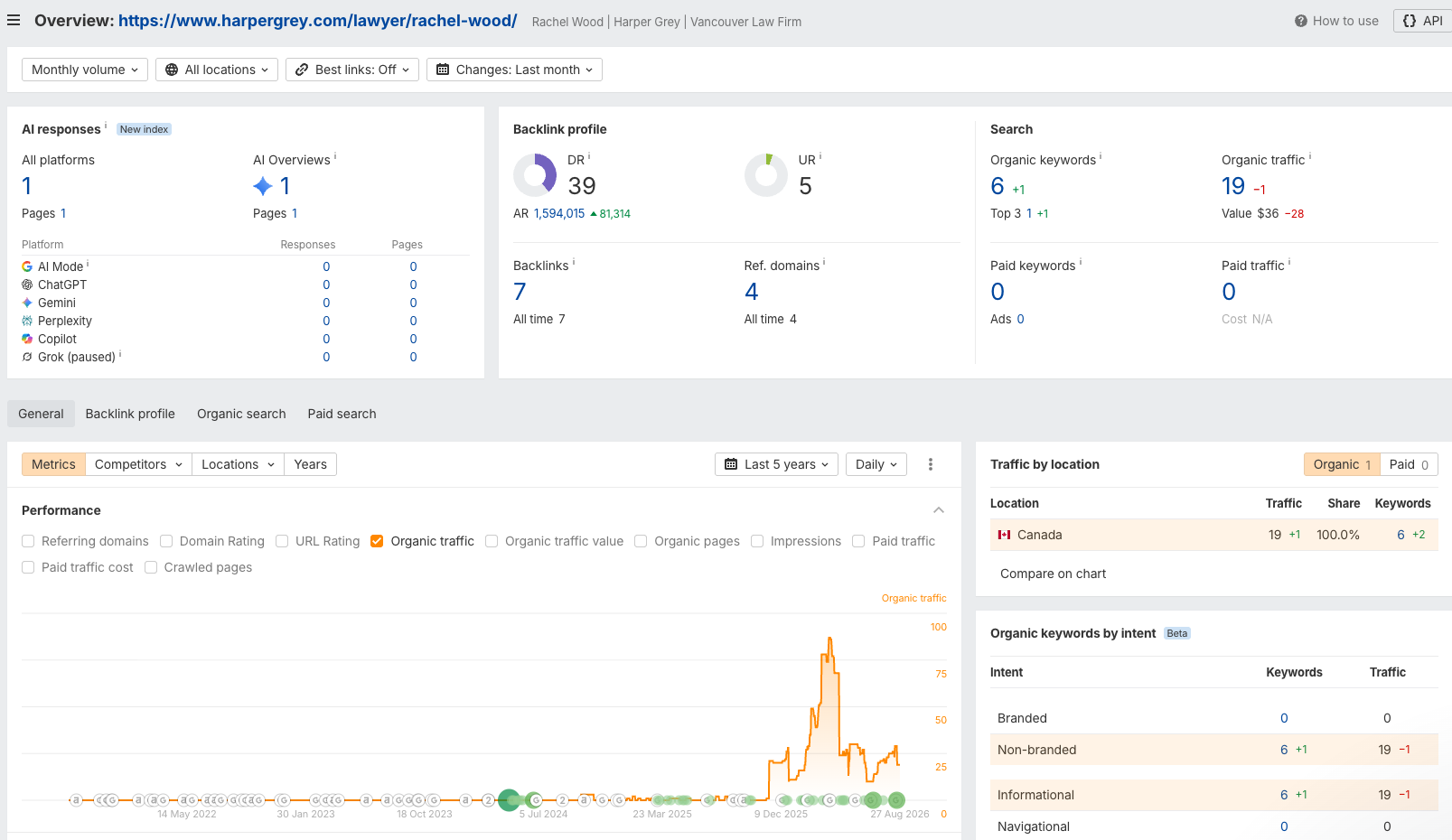
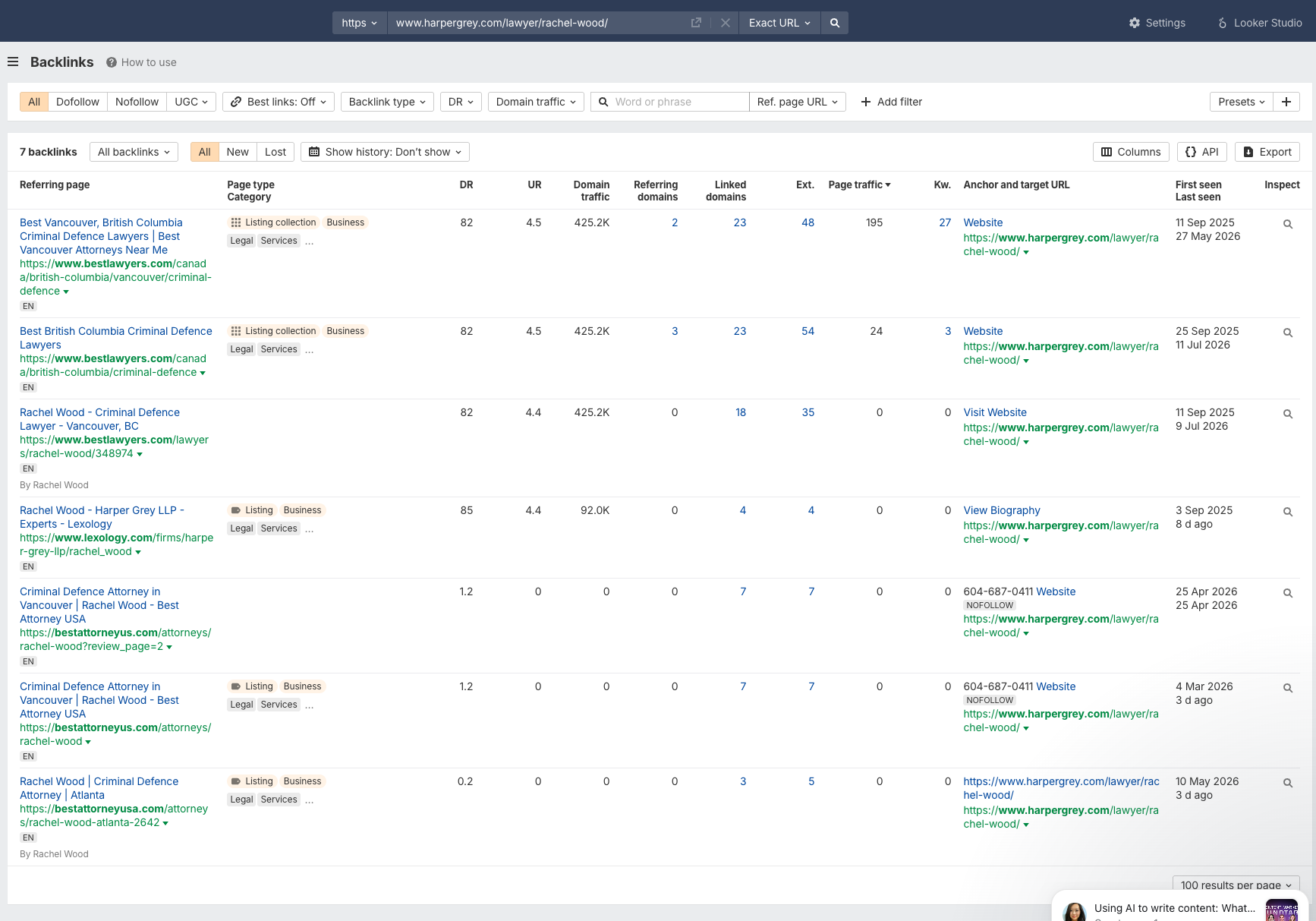
I pulled the numbers in Ahrefs. The family law page has zero backlinks. Zero referring domains. A URL Rating of 5.
It ranks on page one for “family lawyer Vancouver.”
Higher authority. More links. Lower rank.
On a separate query, “criminal lawyer Vancouver,” Harper Grey ranks second. Not with a dedicated criminal law page. With a lawyer bio. Rachel Wood’s profile has no Person schema, no exact match keywords in the title, no meta description. The title reads “Rachel Wood | Harper Grey | Vancouver Law Firm.”
What the bio does have: a line saying she was named one to watch in criminal defence by Best Lawyers in Canada. Memberships in the Independent Criminal Defence Advocacy Society and the Criminal Defence Lawyers Association. Case types listed as homicides, sexual assaults, fraud, Income Tax Act offences. Supreme Court of Canada appearances.
Why entities rank without keywords
Google is ranking the entity, not the page.
When Google reads a page about a criminal defence lawyer, it looks for the entities a criminal defence lawyer would have. Professional affiliations. Case types. Court levels. Third-party recognition. If those match, the page is classified correctly without needing the query string in the title.
Harper Grey’s family law page ranks because the domain carries 119 years of institutional trust. Gala links, event sponsorships, charity partnerships, bar association memberships. A century of the kind of links you cannot buy in a package.
Rachel Wood’s bio ranks because Best Lawyers, bar associations, and the conference circuit all corroborate the same entity: this person practices criminal defence in Vancouver.
In both cases, the entity signals did what keywords and backlinks are supposed to do.
This does not work for every firm. Harper Grey carries 119 years of institutional links and entity corroboration from Best Lawyers and bar associations. A newer firm without that trust still needs exact-match titles. The title tag did exactly what it was supposed to do for every client I have applied it to. Harper Grey is the exception that shows where the game is going, not where most firms are today.
Two people who taught me this
Gyi Tsakalakis said on a podcast years ago to stop chasing high-authority links and get local links and legal links instead. One recognition from Best Lawyers is both.
A veteran SEO, famous in circles for ranking difficult supplement terms, taught me the same thing differently. Is the page linking to you relevant? Does it have traffic? A high-authority site with no traffic and no topical match is worth less than a relevant page that people actually visit.
Harper Grey’s entity corroboration comes from legal directories, bar associations, and peer-review bodies. Every one of those sources is relevant and visited. That is the whole profile.
Ranking without the SEO aesthetic
The lawyer who asked me that question at Hearsay was not being naive. He was asking about taste.
BigLaw and century-old practices do not want “best family lawyer Vancouver free consultation” in their title tag. They do not want their website to look like it was built by an SEO. Nor do they need to, because their links and authority carry them. At this point, people recognize when a site has been optimized, and for firms that trade on reputation, that recognition is a cost.
Harper Grey solved this. They rank on page one. Their website looks like a law firm built it. The title tags carry the firm name and the practice area. Nothing else.
Every other firm on the SERP has keywords in the title. Harper Grey does not. And Harper Grey sits above all of them.
Six years later, 2026
Six years ago, an SEO I look up to published a case study on Harper Grey. Puya Turkiyan’s advanced law firm marketing guide ran his full audit and found the usual list of problems. Weak title tags. Missing meta descriptions. 176 words on a practice area page where competitors had 1,500. No video. No podcast.
His generosity goes beyond his knowledge. I briefly texted him a few years later. He was giving away zucchinis from his new farm an hour away. I was unwell that day and couldn’t make it. He moved to Texas a year later, and then into heavy equipment rentals. We never met in person.
His guide was the first time I saw Harper Grey’s name. Six years later, I’m writing the 2026 update. Perhaps in 2032, another SEO picks it up and updates it again, this time for a set of search results that look nothing like today’s.
The lesson from Harper Grey hasn’t changed in six years. Google is ranking entities. Not pages.
If you want your firm to rank without your website looking like an SEO built it, reach out. We specialize in law firm SEO that respects how your firm presents itself.
Disclosure: NearMe Marketing has no commercial relationship with Harper Grey LLP. This is an independent analysis of publicly available ranking data and backlink profiles. Harper Grey has not commissioned, reviewed, or endorsed this case study. All data referenced was collected from Ahrefs and Google Search in August 2026.